WVSOM outlines potential of Greenbrier Valley Bio Hub at WVEDC Conference
Economic development experts at the West Virginia Economic Development Council’s annual fall conference heard an update on the Greenbrier Valley Bio Hub (GVBH).
Leaders from the West Virginia School of Osteopathic Medicine (WVSOM) shared information and highlighted the economic development potential of the GVBH, which is part of a $35 million renovation and expansion of the school’s Fredric W. Smith Science Building on the WVSOM campus in Lewisburg.
Bioscience Association of West Virginia Executive Director Bryan Brown praised the effort, noting the region's potential for economic development.
“It’s not just adding lab space; it is making the strategic economic development investment in West Virginia’s region. It’s strengthening research, it’s offering workforce development opportunities, it’s creating a platform for public-private partnerships and it’s setting up the Greenbrier Valley to compete for high-value biotech and medtech investments in the future,” Brown said.
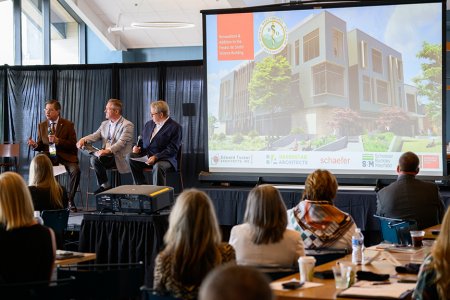
Brown participated in a conference panel with WVSOM President James W. Nemitz, Ph.D., and Chief Communications Officer Don Smith on Sept. 17.
Hosted by the Greenbrier Valley Economic Development Corp., the conference brought together state and federal partners and industry leaders for sessions on a range of economic development topics.
WVSOM’s panel, titled “Making the Greenbrier Valley Bio Hub a Reality,” allowed school representatives to outline plans for developing and marketing the GVBH.
The expansion will add 28,523 square feet to the facility, providing enhanced research opportunities for WVSOM students and faculty while creating space for biotechnology companies and other partners to conduct research. The bio hub will contribute to the growth of West Virginia’s bioscience ecosystem and is designed to attract external researchers and support biomedical innovation and investment to the region.
Nemitz opened with an overview of the school’s statewide impact.
“We are in your communities all over the state. We have seven regions where our third- and fourth-year students fulfill their clinical rotations,” he said, adding that WVSOM is the state’s largest medical school.
Brown said the GVBH builds on the school’s statewide presence by linking WVSOM’s mission to West Virginia’s bioscience industry. He emphasized the importance of research and development to the state’s economy, explaining that West Virginia’s bioscience sector includes health care, agriculture, industrial biotechnology and environmental biotechnology.
“In essence, these industries are helping to heal, feed and fuel the world,” he said.
West Virginia’s bioscience industry employs about 6,000 people across 765 businesses statewide, with average wages significantly higher than the state’s median income. Bioscience-related academic research and development expenditures exceeded $161 million in 2022, and those figures have risen during the past two years.
Smith provided an overview of the economic development strategy for the bio hub and explained why WVSOM considered this undertaking.
“West Virginia is not on the biomedical research map right now, but, to be fair, almost nobody else is either. It’s done at four places in the country: the Northeast, the Carolinas, California and Texas,” he said.
The GVBH will provide infrastructure for biotechnology companies seeking space to conduct research and to develop their businesses.
“Why are we doing a bio hub? Because it’s what we can do. If we were sitting on coal, we’d mine coal. We are sitting on more than 800 medical students who need exposure to research,” Smith said.
He emphasized the importance of securing targeted clients, adding that the first goal is to attract companies that are a good fit for West Virginia. Smith said that this type of development comes with turnover, as companies use the start-up research space to develop their products through the initial phases before moving on to the next steps.
“We want them to start at the Greenbrier Valley Bio Hub and stay in West Virginia, so we will be moving people, hopefully, to WVU, Marshall, West Virginia State and other institutions in West Virginia. Success isn’t filling the bio hub once; it’s filling it again and again and attracting new clients,” he said.
When it comes to marketing the Greenbrier Valley to companies, Smith said the region offers a unique quality of life, with affordable housing, minimal commutes and a standard of living that compares favorably with other biotech locations.
But quality of life can’t be the region’s only appeal. Smith said the GVBH must offer a strategic economic network built through partnerships with the West Virginia Division of Economic Development, the Greenbrier Valley Economic Development Corporation, the Bioscience Association of West Virginia, other higher education institutions, the state legislature, the governor’s office and West Virginia’s congressional delegation.
Nemitz said the emphasis on partnership extends to developing the Bio Hub itself.
“We are good at partnership, we’re good at collaborating and we think we’ll be an excellent partner for private industries coming into the Greenbrier Valley,” he said.
Brown said WVSOM’s collaborative approach will have an impact far beyond the Greenbrier Valley.
“What I’m most impressed by, when you look at what they are trying to do with the Greenbrier Valley Bio Hub, is that they are going to create a system that extends West Virginia’s biotech ecosystem to the southern half of the state,” he said.
WVSOM’s bio hub is under construction and is expected to open in 2027.